Showing posts with label scifi. Show all posts

Tuesday, August 10, 2010

My Favorite Scifi Disasters


I've just finished reading Flood by Stephen Baxter. Like most Baxter books, it is somewhat lacking in compelling characters, but is otherwise jam-packed with amazing ideas and grand visions. It is also an example of a grand tradition in science fiction; the mega-disaster story.

The mega-disaster is an unanticipated event that brings devastation on a global (or even interstellar) scale, and the poor humans have to struggle to survive against the impossible odds brought on by nature's cosmic fury. Because when you think about it, the disasters that we're used to--earthquakes, hurricanes, tornadoes, etc--are really just the tip of the iceberg of what a universe as vast and as violent as ours can throw at us. Humanity as a whole is only slowly waking to the cosmos beyond our tiny blue ball, and the horrors those uncaring forces can wreak upon our lives and civilization.

So what follows below is a list of what I think are the neatest and most thought-provoking disasters shown in science fiction. The criteria to qualify as a disaster here is that they have to be either an accident or a natural occurrence; nothing deliberately brought about by intelligent creatures, human or otherwise. So no invasions, wars, superweapons, etc. Also, inclusion here is not necessarily a reflection of a work's quality, good or bad, but just how interesting the disaster presented was. In no particular order, and beware of SPOILERS:

DISASTER: Megaflood
SOURCE: Flood by Stephen Baxter

Our planet has vast quantities of water stored under the crust. Google "Beijing Anomaly" for a real-life example. Baxter's novel contemplates that a major seismic event along the Mid Atlantic ridge unleashes these subterranean oceans upon the surface, resulting in a decades-long flood that threatens to engulf every single parcel of land on earth, no matter how high. The likelihood of this seems rather remote (the water in the Beijing Anomaly is actually saturated into porous rock, and not a consolidated body of water), but it still makes one think.

The characters mostly scurry about during the novel, more spectators to what's happening than trying to take control of their own fate, one way or another. Even though we know what's coming, its still fascinating to read about how human society breaks down bit by bit as the waters get higher and higher. There's the usual disaster tale cliches (the one scientists who has it figured out before anyone else is ignored and derided, monuments shown in various states of destruction, douchebag survivalists, etc) but it doesn't stop one from enjoying the ride.

REALITY CHECK: The novel is pretty realistic as far how humanity as a whole would react to the disaster. For the people at the end things look dim indeed, as this could pretty much serve as the prequel to Waterworld, when you think about it. But there is a ray of hope at the end, which thankfully doesn't involve a mutant Kevin Costner.

DISASTER: Global Blindness/Murderous Plants
SOURCE: Day of the Triffids

I've never read the book, only seen the 1962 movie, so that's what I'm basing my impression on. This is basically what we today would call a Zombie Apocalypse scenario, except ramped up several notches. Like in a typical zombie tale, you have slow-shambling killers that attack in mobs and want to eat you. But here the killers are the alien plants called Triffids, which move about, shoot poisonous spines at any loud sound, then move over your fresh corpse to suck out your vital juices with their roots. But unlike zombies, they have no obvious weak spot. So all those shotguns and assault rifles you've been hoarding for the collapse not only prove pretty useless, but also attract even more Triffids and tell them exactly where you are.

To make matters even worse, the Triffids were brought to Earth by a meteor swarm, whose weird radiation rendered 99% of the world's population permanently blind. In many ways that's even more horrifying that the killer plants. Imagine you, all your neighbors and your family suddenly being unable to see. You try to adjust and survive, but one by one over the course of days everyone around you goes forever silent. And the last thing you ever feel as you call for them is the sharp stab of a poisonous spine...

REALITY CHECK: The meteor-radiation-causing-blindness thing probably seemed more plausible to 1962 audiences than it does today, but something like the Triffids arriving via spores in meteorites is within the realm of possibility (of course, it might be that the spores themselves that caused the blindness, and people just misinterpreted the data in the panic that followed. For the situation itself, things seem very good by the end of the movie for the sighted 1%, as its found the alien plants hate seawater. Which might be good for the people along the coasts, but the people living in, say, Colorado would pretty much just be screwed. And its pretty much implied that the 99% struck blind are so much plant food.

DISASTER: Super Hurricanes
SOURCE: Mother of Storms by John Barnes

A military strike on a terrorist organization accidentally releases a gigantic reservoir of methane trapped under the arctic ocean floor. The methane leads to a quick unprecedented rise in air and ocean temperature worldwide, and before you can say 'global warming' the warmer oceans begin spawning monster hurricanes far in excess of category five. In short order, island nations like Cuba and Ireland are scoured down to bare rock, and civilization is nearly brought to its knees under a non-stop barrage of wind, rain, and storm surges.

The novel was written in 1995, before climate change really began registering on the public radar, but one of the major effects predicted for global warming is that it would make storms more intense. Barnes just takes that idea to its extreme and gets a good disaster tale out of it. He mixes the eco-crisis with a lot of cyberpunkish ideas (the story is set in 2028) and a wide cast of quirky characters, including a serial killer and a cybernetically enhanced porn star.

REALITY CHECK: Though I don't think storms will ever get near as bad as what's depicted in the novel, its not implausible that we could be facing increasingly intense storms as global warming worsens in the coming decades. In the novel, help unexpectedly arrives from a pair of rogue cyber-astronauts. Given the state of manned space travel today, I don't think that's something we could count on in real life.

DISASTER: Micro Black Hole impacts Earth
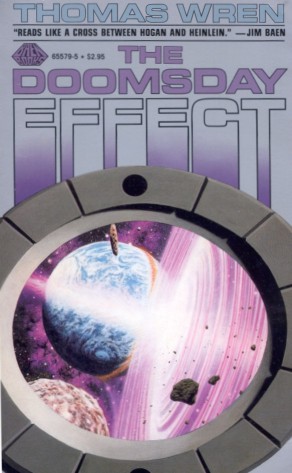
SOURCE: The Doomsday Effect by Thomas Wren

A remnant of the Big Bang, a microscopic singularity, gets caught in Earth's gravity. It enters a comet-like orbit around the planet's core, sweeping up and through Earth's mantle, crust and atmosphere like they aren't even there on every pass. As it grows in mass, it plows ever-larger swaths through the planet, throwing human civilization into a panic as whole cities are destroyed. It threatens to make the homeworld into swiss cheese before finally devouring it completely.

REALITY CHECK: In the novel, they played a complex game of asteroid-billiards to capture the black hole inside one. I'm not sure we'd be capable of something like that for at least a century. So if this happened before then, we're basically screwed, and the bet we could hope for is to establish colonies in space before Earth is toast.

DISASTER: The Moon blasted out of orbit
Source: Space:1999 TV series (pilot)

In the far flung future year of 1999, an international base on the Moon oversees the stockpiling of thousands of tons of nuclear waste on the far side of the satellite. However, on September 13, 1999, that stockpile of exotic radioactives reach critical mass, resulting in a catastrophically huge explosion that blasts the moon out of orbit and into interstellar space. The fate of the 311 stranded inhabitants of the base are thrown in with the errant satellite as it careens through one star system after another.

REALITY CHECK: Pretty preposterous the way it was presented. The radioactive waste would have had to have been made of pure antimatter to create an explosion big enough to possibly send the Moon out of orbit, and even then it would have been more likely to just be blown apart rather than just move. Some other factor had to have been at work (as I contemplated in an EARLIER BLOG POST.)

Still, if something like this did happen, there would be potentially catastrophic results for Earth. In the short term, tides would disappear and wreck ecological havoc with many species who depend on them. In the long term, the Moon's tidal effects is what keeps Earth's core 'churned up' and active, resulting in the magnetic field that helps to protect life from the worst effects of solar radiation. So without the Moon, over many thousands of years the magnetic field would diminish and threaten many future species.

Also, what of the explosion itself? A nuclear detonation that powerful that close to Earth would produce enough radiation to fry just about anything electronic in orbit and may even screw up a lot of ground-based systems.

DISASTER: Earth collides with a small star
SOURCE: When Worlds Collide

In this classic 1951 film, a 'dim star' named Bellus is found to be on a collision course with Earth, and will hit within one year. An alliance of businessmen and scientists begin constructing a ship that will take a relative handful of survivors to safety, even as panic and disaster grows more intense as doomsday approaches.

REALITY CHECK; I already wrote extensively on what might happen if this scenario were to happen today in a previous blog post. Go HERE to read all the details of that.

DISASTER: Galactic Core Explosion
SOURCE: various "Known Space" stories and novels by Larry Niven

The alien Puppeteers wanted a stunt that would advertise their new hyperdrive, so they hire human pilot Beowulf Schaeffer to pilot it to the center of the galaxy. Schaeffer discovered that the core of the galaxy is exploding from a chain of tightly-packed stars going supernovae, and that the lethal wave of radiation would wash over Known Space, including Earth and the Puppeteer homeworld, in 20,000 years.

The Puppeteers, wily cowards that they are, immediately pull out of Known Space and even begin moving their entire home planet to safety.

REALITY CHECK: We've learned in the decades since that the galactic core can indeed explode aftre a fashion, but from the supermassive black holes there gobbling up large masses of stars all at once, rather than a chain of supernovae. In the stories, humans and other races think the Puppeteers are insane for moving so fast, considering the shockwave of radiation in 20,000 years away and everyone has hyperdives. Of course, the Puppeteers think the humans and the others are insane for not fleeing right away.

Since the galactic core black hole gorges itself every few hundred million years, life on Earth must have withstood the influx of radiation from it before. However, last time it happened, there might have been no significant multicelled organisms, or life on land. How it would affect us today if it happened is largely unknown.

DISASTER: The Sun-Eater Devours the Sun
SOURCE: The Final Night, a 1996 miniseries/crossover event from DC comics

The Sun-Eater is a gigantic multi-dimensional creature the feeds off the energy of stars. It seemed to be non-sentient, a cosmic-scale animal intelligence simply doing what it has to to survive. It will enter a star system, completely envelop the sun, and feed off its thermal energy for up to several weeks. The absorption of so much heat causes the outer layers of the star to collapse then explode outward. The force of the explosion sends the Sun-Eater to the next solar system and its next meal.

Of course, for inhabitants of the planets orbiting the star the Sun-Eater is devouring, this is a lethal proposition. And that's exactly what happens to the DC Comics' Earth. The sun simply turns black one day, and Earth begins to slowly freeze. There's widespread panic and devastation, and the superheroes have their hands full containing it all. Meanwhile, only a handful suspect that the freeze is only a precursor to a much more explosive doomsday that will soon follow.

The Final Night is by far one of my favorite super-hero crossover stories, back when I was reading comics regularly. DC brought in hard science fiction author Larry Niven as an advisor, to create a plausible (in comic book physics terms) scenario for both the Sun-Eater's nature and what would happen to Earth after the sun goes black. The most intriguing part of the story was how the various super-heroes handled the crisis. Though powerhouses on a human scale, even the likes of Superman, Flash, and Green Lantern are reduced to insignificance next to the Sun-Eater's god-like power and indifference. Plus, there was nothing to throw a punch at or outwit; the Sun-Eater was a force of nature far beyond even them. In the more thoughtful installments of the story, even they give over to feelings of despair and helplessness, even as they fight to save whoever they can, even if it is only for a few hours more of life.

REALITY CHECK: The Sun-Eater seems pretty implausible. But then, our universe is immensely old and big, so who know what oddities it might have spawned? In the story, the characters were able to Deus Ex Machina their way out of things at the last minute by appealing to a cosmic-powered peer of the Sun-Eater. If something like the Sun-Eater ever struck in real life, I doubt we'd be able to do the same.

Thursday, July 1, 2010

Review: Rocket Girls


JAXA (the Japanese Aerospace eXploration Agency) has been in the news a lot lately, with their automated cargo ship to the ISS, their asteroid-sample return mission, and their deployment of the world's first solar sail. It was through talking about JAXA in online forums that I ran across the mention of this 12-episode TV anime series, on which JAXA served as technical advisor and real-life Japanese astronaut Naoko Yamazaki, who flew on STS-131, voices a small animated cameo as herself in episode 7. Rocket Girls is based on a series of light novels by Hosuke Nijiri and is available in english on DVD and for viewing online.

At first, this series seemed like the usual teenage girl action-comedy anime fluff. You know the kind; pilot slick mecha, fight outrageous aliens/demons, crush on teenage boys, something-something girl power. To my pleasant surprise, Rocket Girls turned out to be anything but, and had more in common with Planetes than say, Sky Girls.

The Solomon Space Association (SSA), a consortium of private Japanese companies trying to create a manned launch facility on the Solomon Islands, keeps having catastrophic failures with their large LS-7 rocket. So, in order to make their deadline and keep their funding, they fall back on their smaller but much more reliable LS-5 rocket. The only problem is, that requires their potential astronaut to weigh less than 40 kg, or about 88 pounds.

At the same time, waifish but fiery high school student Yukari Morita is also in the Solomons, trying to track down her deadbeat dad who left 17 years before. Through a comedy of errors, she ends up together with SSA's ever-more-desperate director, who hires her on the spot as an astronaut since she's the perfect size for their new rocket.

Soon a back-up pilot is found among the Solomon natives; Matsuri, who turns out to be Yukari's half-sister (this and the father subplot is quickly resolved in the second episode, so I don't consider this to be a major spoiler.) Half-way through the series, they're joined by a third girl, Akane, a genius science nerd from Yukari's old school.

At first the high-school-girls-in-space premise seemed a little off-putting, but I started watching episodes about the same time that news stories were headlining a 13-year-old climbing Mount Everest and a 16-year-old attempting to sail around the world solo. Then I realized the only thing realistically keeping anyone from launching a teenager into space is someone reckless enough--or desperate enough--to actually entrust them at the top of a multi-million dollar rocket. And as SSA's own director points out, if monkeys can be astronauts, then why couldn't a teen-age girl?

Once past that bit of rationalization, Rocket Girls turned out to be an extremely likable series, mostly comedy but also some moments of real drama, excitement, and even inspiration sprinkled throughout. One can kind of think of it as The Right Stuff populated with high school girls and played as a sitcom.

The series has three strong points. First and foremost are its characters. The three girl-astronauts are the only ones who are really well detailed, but for a 12-episode series, we really can't ask for much more. Yukari, the main character, is bold and brash and abrasve. At first, she resists becoming an astronaut, obsessed with finding her dad and forcing him to come home to Japan, and then with having a few Peter Parker moments where she believes she'd much rather just be a normal high school student rather than embrace this extraordinary thing that's happened to her. In fact, most of the series can really be thought of as her slow growth from petulant high school student to responsible heroine.

Matsuri, Yukari's half sister, starts off as a badly stereotyped generic Native Girl, but she too undergoes growth and maturity as the series progresses. Though mystical and supposedly naive about modern society, she turns out to be the most practical-minded and down-to-earth of the three girls. I only wish she had more to do during the last five episodes or so, as she mostly became the voice of Mission Control.

The third astronaut girl, Akane, was the most surprising, and surprisingly inspirational, character. Looking and often acting so frail that a harsh breath could break her in two, she shows up unexpectedly to fulfill her dream of going into space. Whereas the job of astronaut just kind of fell into Yukari and Matsuri's laps, Akane pursues it with unflinching determination, inspired by Yukari after a (very) unexpected stopover at her old school. Akane gives the series its most Right Stuff moments, as the base doctor puts her through a series of truly grueling physical tests to try to get her to quit. Not out of cruelty, however, at it first seems. The doctor explains that there is no one in space to help you; if something happens, you have to be able to save yourself. In other words, you have to have the 'Right Stuff.' Akane's heroic underdog struggle to join Yukari and Matsuri as an astronaut is probably the series' single best story arc.

The second important element to the series' success is its solid and realistic science. Its not ironclad, mind you, but its very easy to see how JAXA made sure it got most of it right. When it does occasionally veer off on a minor tangent, only space buffs or real engineers will be bound to notice. There's no fantastic mecha or megawapons here. Yukari and the gang fly very basic space capsules barely big enough to fit them, with design features borrowed from Soyuz, Apollo, and the Space shuttle in equal measures. The tech is idealized, ie, what JAXA would love to have when it begins launching its own astronauts for real, but not unrealistic.

One interesting tech note is that the girls wear advanced biosuits (you can find details of that tech idea in the article HERE.) The joke here is that the skin-tight fabric shows of the girls 'attributes' and makes them feel practically naked. But the thing is, what the audience actually sees in the anime hardly looks scandalous at all, and is even more modest than the spandex outfits of say, gymnasts at the Olympics, who usually have millions watching, so the joke kind of falls flat. This is not to say that the series doesn't have some cheesecake shots (this is anime, after all), but they're mostly fleeting and relatively tame.

The third feature that makes this series worth watching is that intangible quality all great science fiction shares, and all the bad science fiction lacks: a true sense of wonder. Rocket Girls is very light on violence, except for occasional comedic effect. There are no monsters or aliens to fight, no constant threat that requires constant kinetic motion. Instead, the series allows its characters to look around and feel just how awesome what they're doing is. Yukari, even in dealing with a major problem on her first mission, is hypnotized for a few moments in naked wonder at seeing the unfettered night sky from space. When she talks about it later, in her phase of trying to be a normal student again, you can hear the unexpected longing in her voice as she describes the experience to the rapt Akane. And the SSA's lead scientists give a short, impassioned speech early in the series about his heartache and dreams about spaceflight that gave me goosebumps. This optimism and inspirational spirit, plus its realistic science, is what made Rocket Girls remind me in small ways of Planetes, which I consider one of the all-time classics of science fiction, of any genre. Rocket Girls never quite achieves the same level of storytelling as that other series, but at times it is clearly cut from the same cloth.

The series's drama comes from two space missions, Yukari's first flight half-way through, and an assist mission to the Space Shuttle Atlantis in the last three episodes. Mishaps and unexpected disasters occur, and the girls are tested in many ways. I actually I found these encounters, with all their nuts-and-bolts grittiness, to be much more compelling to watch than a dozen mecha battles.

Rocket Girls is far from perfect, however. There's some gaffes in logic, and sometimes the plot twists are a little too unbelievable, even if they are played for comedic absurdity at times. Many of the secondary characters are underdeveloped, though we see hints of much deeper characters here and there. And the balance it tries to strike, switching off from comedy to drama to philosophy to action and back again, doesn't always transition smoothly.

However, in the balance, Rocket Girls turned out to be a very pleasant viewing experience. Its safe for most ages (12+), and may even inspire some young budding astronauts, to whom its clearly angled. It is also smart and savvy enough to easily entertain adult science fiction fans as well.

Sunday, June 27, 2010

Five Years Of Orbital Vector

About five years ago last month I launched the Main Orbital Vector site. I had an earlier test site, called the SpecTech database, that was online a year or two before that.

As a budding science fiction writer at the time, I had been frustrated that I couldn't find what I considered a good, detailed, straight-forward database of science fiction or speculative technology ideas. It was easy to find some concepts (like space drives) but not so much others (like futuristic ocean tech.) So, gathering up the plentiful notes I had floating around from research I did for various stories and RPG games, I organized them and decided to put them online for anyone else who may be interested.

The site was slow to catch on, and truthfully its always been a sideline, pretty much a hobby, so I never really publicized it that much. But it eventually got noticed by various like-minded users, and it gained in popularity gradually mostly by word of mouth. Nowadays it averages between 20-30 hits a day, and seems to be on a slow upward trend in user hits.

If you like the site, its probably for one or more of three reasons. One, I've tried to make Orbital Vector mostly about its content, and to make sure that content was useful, interesting to read, and easy to get to. I know I kind of suck as a web designer, so I stuck with a simple design that even an amateur like me could keep up with, and concentrated mostly on the articles.

This is not to say that all my prose has been sparkling, or that my writing is without errors and gaffes. This is like I said a hobby, so this is what I do when I'm too tired or burnt out from other stuff, and sometimes that creeps into the articles here as clunky prose and typos and broken links and such. But the readers thankfully seem to be pretty forgiving of my occasional botched english or coding.

Two, Orbital Vector is also more subtly about optimism for the future, which I know from emails that a number of users really respond to. After all, through all these neat tech concepts and ideas, we're showing just how awesome the future could end up being, and perhaps more importantly, that we'll still be around to enjoy it. There are a lot of dire predictions and attitudes about the future floating around; I wanted to make OV a bit of an oasis from that.

And Three, you just like learning about future technology and may want to use the ideas here for your own stories or games or art or what have you. That's what I originally created the site for, and I'm glad to see people take advantage of that. The articles on OV are written specifically for the layman who may not have a lot of scientific or technical background, but still want enough detail for them to understand how its supposed to work.

I only update OV sporadically, when I get time between other things going on in my life. I try to get 2-3 articles out a months, but sometimes its more, and sometimes its less, just depending on what else may be occupying my time.

Some people ask why I emphasize some technologies but not others. For example, I have an awful lot written on space tech, but very little on medical tech and nothing at all on things like cybernetics.

Mostly, I've tend to write about things I already know quite a bit about already. I read up a lot on new science and technology, but naturally I tend to be interested in certain fields over others. Stuff I haven't read a lot about, like advanced medical tech, requires a lot more time and effort for me to research and write about, so I tend to let that stuff go in favor of things I can produce sooner.

Plus there are some fields that are turning over new tech so fast that its hard to keep up. Electronics, for example. Things that seem futuristic to us now could easily become the next big consumer product in just a few short years. And when a speculative technology becomes commonplace, it doesn't belong on OV anymore. So I kind of have been edging away from electronic and computer speculative tech, as I'd rather not have to write an article that I would just have to remove six months later.

So what's going to happen to OV in the future? More of the same, really. I'll keep adding new articles when I can, filling in gaps in the old sections, adding new ones when I can. There will be some new features though, depending on when I can get around to them:

-- One, I'd still like to convert the site from HTML to CSS. The effort earlier in the year kind of fell through, but that's still on the agenda.

-- Two, i'm going to be adding some donation incentives, and some Orbital Vector swag people can buy. The site makes just enough from ads to pay for its own webhosting, but I'd also like to be compensated, at least at a token level, for the time and effort I put into the site as well. But I will make sure that whatever I offer is quality stuff, so if you do contribute, you'll get something in return that will be worth it.

-- Three, I'm going to be trying to put together some non-fiction books based on the material I've written for the site, so you might see OV in print some day. We'll see how that goes, and if I can find a publisher for it.

-- Four, I'm going to be revamping the Author's Page with a simpler design and new material. That's long overdue.

-- Five, I'm also toying with the idea of adding a Gamer's Page, which would focus on material for science fiction tabletop RPGs like Traveller. I used to game a lot myself, and even wrote a little for gaming magazines, way back when. I know a lot of gamers already use OV for tech ideas, so it seems like a natural extension.

So anyway, thanks for five years of readership and support. Hopefully Orbital Vector will still be here five years form now. See you guys in the future!

Tuesday, June 22, 2010

MORE Tech Levels Of Science Fiction Groups And Cultures

This is a follow up to the ORIGINAL ARTICLE put up on the main site two years or so ago, detailing where exactly on the Tech Level scale different scifi civilizations would fit. It was by far the most popular thing ever put on the site, garnering over 100K hits since.

Tech Levels are based on the idea that, looking back, human history can be divided into distinct eras of technological development (stone age, bronze age, iron age, middle ages, etc). The Tech Level scale assigns a number to each of these, and tries to predict which future technological era a new innovation might fall. On the OV scale, there are 10 Historical Tech Levels (stone age = 1, iron age = 2, etc) and 15 Future Tech Levels (10 years from now = 11, 25 years from now = 12, etc.) Tech Level 10 corresponds to modern day Earth. For more details, see the articles on Tech Levels HERE and HERE.

On the OV scale, we look at a future idea or invention, and based on what we already know and are capable in the early 21st century, how long it would take to create that innovation for real. Yes, there are a number of speculative technologies that are in all likelihood impossible (such as FTL travel) but for our purposes here, we ask that if it is possible, how advanced technology in general would have to be in order to invent it.

Different people and properties have very different ideas about the pace of technological progress. For example, in the Star Trek universe, Warp Drive is discovered in the next 50 years or so, at Tech Level 13. But at OV, we assume warping the fabric of space to that degree is much more difficult (if its possible at all, of course), and isn’t doable until at least Tech Level 21. Both views are legitimate; its only a matter of interpretation.

Some caveats to clear up some confusion that arose from the last article (all conditions from the previous article apply as well):

This is a subjective interpretation only and not meant to be authoritative. People can, and should, have their own opinions.

This is not meant to imply the quality of storytelling or production of one particular property over another. This only compares the tech curve created for each scifi property against the tech we have in reality.

I’m sure I’ve left out a bunch of scifi properties still, particularly scifi computer games. I simply haven’t seen/read/played everything yet, and others I may have just plum forgotten about. Apologies.

This is meant purely for FUN. Relax, nerd out a little, and don't be afraid to let us know your own thoughts and opinions.

- - -

Fringe (Alternate Universe)

Tech Level: 12

The alternate universe accessible in the TV series Fringe seems to be 20 or so years ahead of its sister Earth in its mainstream technology, with more advanced electronics, biotechnology, and sophisticated airships. Interdimensional and other weird tech, given the nature of the show, will likely remain in the superscience prototype stage on both Earths.


Planetes

Tech Level: 14

One of anime’s truly great science fiction stories, Planetes takes place in 2075, when the world’s powers have harnessed helium-3 fusion, colonized the Moon, and have built an extensive orbital infrastructure.


WALL-E (WALL-E himself)

Tech Level: 14

A sophisticated and long-enduring AI robot system that evolved to sentience over the course of centuries.


2300 AD

Tech Level: 15

Game Designers’ Workshop’s late, lamented space opera RPG had a very hard science, nuts-and-bolts approach, even more so than its big brother Traveller. (Will be reviewed on this blog soon.)


Cowboy Bebop

Tech Level: 16

The creators of the anime classic Cowboy Bebop played fast and loose with technology in the series, freely mixing space opera tech (like warp gates) with earlier anachronisms (like 20th Century firearms). Still, a sprawling interplanetary civilization, terraformed worlds, advanced AI, and advanced genetic manipulation place it at about level 16.


Battlestar Galactica (New and Classic Series)

Tech Level: 17

Large and sophisticated spacecraft, fusion power, very advanced AI and robotics, place both series, humans and cylons both, squarely into the lower space opera Tech Levels. The main differences in tech between the two series seems to be that the classic series relied on energy weapons and force fields more and had less sophisticated robots, while the new series had less sophisticated weapons and more advanced robots(pictured at top.)


Revelation Space (Humans)

Tech Level: 17-18

The human civilization in this series by Alistair Reynolds seemed to have created a very sophisticated sublight civilization that had colonized a number of nearby star systems before running afoul of the Inhibitors, with the Conjoiner faction being one level ahead of the mainstream civilization. The Hell-Class Cache weapons described in the novels are considered one-time superscience prototypes, and aren’t used for classification here.


Farscape

Tech Level: 18

Though it has interesting takes on a number of technologies, the societies of Farscape seem to fit fairly comfortably into the role of typical space opera civilizations, at level 18.


Wall-E (Axiom)

Tech Level: 18

Ubiquitous force fields, sophisticated anti-gravity, extremely versatile and powerful AI robots, seems to indicate Earth reached an amazing level of sophistication before the Axiom and her passengers abandoned it.


Type I Civilization

Tech Level: 18

In the classic scheme of characterizing advanced civilizations, a Type I civilization is capable of harnessing the energy potential of entire planets. Assuming that this includes taking advantage of every energy source available on a planetary scale, including tapping the planet's molten core, the tidal energy of its oceans, and the planet's magnetic field, this should fit fairly comfortable at Level 18 on the OV scale.


Type II Civilization

Tech Level: 21

A Type II Civilization in the classic scheme of characterizing advanced cultures stipulates harnessing the energy output of entire stars. With the creation of advanced Dyson Spheres, this capability comes at Level 21.


Transformers (Live-Action Movie)

Tech Level: 21

The living, quick-morphing, fast-healing AI robots of the film, along with the technology-altering Allspark energy source, would seem to require at least Tech Level 21 to construct. Interestingly, both factions of robots in the film seemed to have lost the very technological knowledge that was used to create them.


Gateway (The Heechee)

Tech Level: 21

Able to easily manipulate mass and gravity, create ultra-tensile strength materials, and hide out within the event horizons of black holes place the Heechee at about level 21.


The Culture

Tech Level: 22

Iain M. Banks’ far future utopian society is capable of building immense ringworlds (‘orbitals’), using sophisticated antimatter power and AIs, and routinely employs force fields, teleportation, and advanced nanotechnology.


Revelation Space (The Inhibitors)

Tech level: 24

Immensely powerful and advanced femto-machines left over from an eons-old war, they are charged with destroying any civilization in the Galaxy that reaches a certain technological level.


Type III Civilization

Tech Level: 25

A Type III Civilization is capable of harnessing the energy of an entire galaxy. How exactly this could be done is pure conjecture at best, and thus falls at the edge of what we can reasonably project even with the best guesses of speculative technology provided here.

- - -

I'll no doubt do another update like this sometime in the future.

Sunday, June 6, 2010

Hidden Treasures Of Science Fiction: Traveller!


Popular science fiction works tend to fall into two broad camps: Those that focus mostly on exploration stories, such as in Star Trek's various incarnations, which deal with venturing into the unknown. Then there are battle stories championed by Star Wars and its many imitators, which deal with conflicts and wars, either overt or covert, fought between various factions in a fantastic setting.

But there is a third, less often seen type of science fiction adventure, which the Traveller tabletop RPG champions so well: the scifi road trip.

Like most freeform tabletop RPGs, Traveller can encompass almost any type of story or activity within its setting. It all depends on tastes of the GM and players. But the game is set up almost always the same kind of overall structure: the player characters travel around in small, often beat-up starships, visiting planets within a gigantic interstellar civilization called the Imperium, with no nobler intention than earning a living and just seeing the sights.

They may be merchants, trying to stay one step ahead of the mortgage on their 30-year old merhcant trader. They may be enjoying retirement cruising around in one of the scout service's old surplus starships. They be ex-military bouncing from one mercenary contract to another. They may be scoundrels or refugees or agents fleeing their past. But no matter how you slice it, Traveller campaigns tend to feel like the far future equivalent of setting off on an open highway with a whole continent ahead of you. But instead of a beat-up chevrolet and untold miles of asphalt, you have a worn-down scout/courier starship and the thirty thousand star systems of Charted Space.

Traveller is definitely a working man's, middle-class, vision of science fiction. There is great emphasis in the game on just making a living, including an elaborate system on working out trade and money-making cargoes, and the like. Granted, the characters make a living in what to us seems a very exotic way, hopping from star system to star system, but they need not engage in anything loftier than the pursuit of the Imperial credit if they don't want to. The characters are also not great movers and shakers, and probably won't be determining the destiny of the galaxy. And they most likely won't be going anywhere that hasn't already been charted and explored at least cursorily by someone else. But its new to them and what happens along the way is important to the people that they meet. Like any good road trip, its about the experience and personal discovery, and that's what has always helped to make Traveller such a rewarding RPG to play.

The game has gone through many different revisions and updates since its introduction in 1977 by Game Designers' Workshop (GDW.) The original incarnation of the game, what's now called "classic" Traveller, ruled for the first ten years. It was set in the 57th century, when explored space was dominated by the 11,000-world Third Imperium and its surrounding states. In 1987 GDW updated both the game mechanics and the background, called MegaTraveller as the Imperium shattered into more than a dozen warring states after the assassination of the Emperor. In the early 90s, GDW introduced a new update, Traveller: The New Era, which took place seventy years later as interstellar civilization tried to recover from the apocalyptic war that ultimately resulted from the shattering of the Third Imperium.

Unfortunately, GDW suffered the fate of many game companies of that time as the RPG market imploded. The license was picked up by STEVE JACKSON GAMES and was released as GURPS Traveller, which took place in an 'alternate' timeline where the Third Imperium never disintegrated. The games' original designers tried to reboot the game on their own, with a version called Traveller 4 or more simply T4. There has also been a D20 version.

Today, Traveller lives on at MONGOOSE PUBLISHING and is backed by many of its original creators. The game's historical clock has been set back to the beginning year of Classic Traveller, with the future of its fictional universe wide open. Steve Jackson Games also continues to support its own version of the game.

One aspect of Traveller's game mechanics I always really enjoyed was its character creation. It was way ahead of its time in creating nuanced, interesting player characters, when most other games had PCs who were mostly collections of basic stats and an alignment.

InTraveller you don't just create a character, you create a career for him or her. After rolling base attributes, you 'enroll' him in a chosen job--soldier, starman, merchant, etc. Then you work the character through year by year, gaining skills, rank, and benefits. The more years your character goes through before mustering out, the more skilled he will be, but the older he will be as well, and may be subject to the dreaded aging rolls, that could decrease strength or endurance or such. Thus, most characters don't enter the game as snot-nosed young punks, but people in their thirties or forties (sometimes older) with a lot of life experience and stories already behind them that the GM and player can draw upon for inspiration in the game.

Another very cool aspect of the game, at least for a techno-nerd like me, is its vehicle and starship design systems. Its changed somewhat from version to version, but allows one to create almost any kind of customized, detailed vehicle for use within a campaign. One can design anything from a basic gas-powered motorcycle up through a 500,000-ton interstellar battleship. Many a fan website of the game is overflowing with such original designs.

The game's setting is one of the most highly detailed ever created, either for a science fiction setting or an RPG universe. In fact, in the late 80s, it purportedly surpassed both Star Trek and Star Wars in terms of sheer amount of written material created for it (of course in the years since both those franchises have catapulted ahead again.) Just check out the TRAVELLER WIKI to get a taste for its expansive universe.

The Third Imperium is a very wide and diverse place to explore, with a very classic space-opera feel to it. Humans and human variants dominate explored space, thanks to a mysterious race of 'Ancients' who trasported prehistoric humans from Earth to dozens of different worlds to use as slave labor (a plot point also used by the Stargate franchise years later.) In fact, two of these 'other' human races beat us Earthers into interstellar space by thousands of years.

There are also major non-human races, such as the Aslan, the Hivers, and the K'Kree; and hundreds of 'minor' races who never achieved interstellar flight on their own. In fact, one of Traveller's great strengths as far as its background goes is the amazing amount of detail and verisimilitude it gives its alien races. They all come across as believable.

But despite being a classic-type space opera, the game's setting is also very nuts-and-bolts when it comes to its technological details. The idea of detailed Tech Levels on OV originated with Traveller (but it also has been borrowed by many others as well since), and the Imperium is made up of a huge diversity of planets at different Tech Levels, from Rennaissance-level worlds, to those equivalent to modern day Earth, to worlds with Star Wars level tech or better. Each world is allowed to develop on its own and tend to its own affairs, as long as it pays at least token tribute to the Imperium. This technological diversity, along with the huge variations in physical conditions and culture and inhabitants, creates an amazing array of possible worlds that player characters can visit, pretty much ensuring that their interstellar road trip never need be boring.

Of course, not every aspect of the game is rave-worthy. Some compromises had to be made in order to keep it accessible to the average, non-science-savvy player. For example, the Imperium and its neighbors inhabit very three-dimensional space, but all the game's star systems are mapped out on two-dimensional hex grids. I also never really liked the game's use of psionics; when I ran a Traveller campaign years ago, it turned out to be the single most unbalancing element of it.

But even so, if you have a gaming group and are getting tired of endlessly bonking orcs and hoarding gold pieces, you may want to give the interstellar adventure of Traveller a try. Its well worth the time to seek out its source material, both old and new.

Saturday, May 22, 2010

When Worlds Collide Unlimited


When Worlds Collide was always one of my favorite classic science fiction movies. For its time, it was surprisingly hard science. Even today, allowing for its more primitive special effects, one would be hard pressed to find a real gaffe in the science as known at the time it was made, or in the realism of the scenario presented. I won't lie either. When I first saw the film when I was 10, it scared the heck out of me. I basically spent the entire night after watching it lying awake and worrying if Earth was still going to be there in the morning.

In the movie, a dim star named Bellus is found to be on a collision course with Earth. With barely a year before impact and facing skepticism from all sides, a group of indusrtialists and scientists begin frantic construction of an experimental rocket ship that could carry at least some human survivors to Zyra, one of Bellus' planets that could possibly sustain life. Altruism and selfish survival tug back and forth at the crew building the rocket ark, as they all try to battle the most most implaccable foe of all--the inexorable countdown to doomsday.

There's a remake scheduled for 2012. We'll see how that goes when it comes out, but given the quality of most remakes lately, I don't hold out much hope for it.

Even so, I always wondered: what would happen if the world today were to face the same kind of scenario? This entry explores a bit of what I think might happen.

The modern world of 2010 has a number of advantages that 1951 Earth didn't. For example, our astronomical observation abilities are far more advanced, and there's a lot more eyes (both pro and amateur astronomers) turned toward deep space. A 'dim star' like Bellus would probably be detected a lot earlier. So for my little pretend scenario here, I give Earth at least 5 years to prepare for the impact, instead of the one in the movie, though the lead time might easily be much longer than that.

Also, Bellus would likely be what we today call a Brown Dwarf. It radiates heat (infrared radiation) but very little light, and would likely first be detected through an infrared telescope. So though dimly lit, it is possible for Zyra to be friendly to life, if its at the right distance from Bellus. It also makes it possible for the Bellus to escape detection earlier, especially if it was moving particular fast with regard to our own star system.

Second, space travel is no longer a fanciful notion as it was in 1951. With our current capabilities, we can't go very far or very fast, but we already have a great deal of experience with both constructing and launching spacecraft.

I don't think it would be a matter of IF we could get survivors to Zyra, but how many and by what method. And how many crazies would stand in the way.

With five years to prepare and enact a plan, how smoothly would that go? In the movie, there were a number of skeptics who kept the governments from doing anything substantial at first. In the modern world, that would happen as well. There would be a huge amount of resistance to doing anything at first--look at the prevalence of global warming deniers who took one bad winter as 'proof' that climate change wasn't real. Or all those who denied that the housing bubble would collapse until it crashed the global economy. Many people just seem to refuse to buy into any prediction of bad news, no matter the amount or quality of evidence presented to them. These would inevitably include some people in power, who would gum up the works as best they could.

But there would also be those who would fully believe from the start that Doomsday would be coming, and would kill anyone who would try to prevent it. Mostly these would be religious extremists and doomsday cults, such as the Hutaree that were in the news recently. They would see the coming collision as the Rapture and would actively fight anyone who would try to thwart what they would see as God's will.

However, I don't think either faction would win the day, and with evidence mounting, governments and corporations and most other major organizations with power will begin making preparations. Very likely, the major world powers would cooperate as much as practical, as coordinating efforts and resources would assure the greatest chance of any individual nation's efforts succeeding.

So what could we specifically do?

Deflection of Bellus is completely impossible without at least Star Trek-level technology. Its just too big and massive. Hitting it with all the world's nukes combined would be like trying to move an aircraft carrier by throwing a firecracker on its deck.

So like in the movie, the best bet would try to get as many survivors, along with equipment, food, medicine, crops, and animals, to Zyra as it passes.

One way of doing that I read about on some forums like Reddit: using a Nuclear Launch Cannon (NLC), the details of which can be found HERE. Under normal circumstances, the environmental and political controversy such cannons would create would likely prevent them from ever being used. However, with Doomsday quickly on the way, I think the major powers would agree that such things no longer mattered, and would begin using them as soon as they could be manufactured. And with thousands of nuclear weapons still readily available, they wouldn't lack for propulsion charges.

The NLCs could put many thousands of tons of habitats, ships, supplies, and equipment into orbit and Zyra-intersecting trajectories. So unlike the movie, there will be more than one or a handful of ships to make it to Zyra. The survivors will have plenty of tools and equipment to help them.

But even if NLCs aren't used for some reason, there's still a lot one could do with conventional rockets for hauling up cargo. Both the US and the USSR developed heavy-lifter rockets in the 1960s within a handful of years, and Russia still maintains theirs. Since its already a known and well-used technology today, it would probably take less than two years for most of the major industrial powers to re-gear themselves to produce heavy-lifters in quantity, if they were really motivated to do so.

Among the equipment provided would probably also dropships. Just getting the survivors into orbit and having them make the interplanetary crossing would be a tremendous feat, and having less mass to consume fuel would help greatly. So part of the plan may be to have the survivors dock with drophips in Zyra orbit, which will ferry them on their final leg of their journey.

Getting the people up there would be a more complicated matter. NLCs would kill any living thing launched from them; the G forces would just be too great. So it would depend on conventional rocket technology to get them into orbit and transfer them to Zyra.

Thing is, how many would that be? In the movie, the characters had to wait until the last possible moment before the collision to launch, to conserve as much fuel as possible. I really don't think anyone in a modern day scenario would risk that if they didn't have to. The unmanned cargo vessels could be launch early and take trajectories that may encompass months or years to get to Zyra as it approached. The manned vessels would be more problematic.

We already have one long-endurance space habitat available: the ISS. Take a year to kitbash it with better rad shielding and maneuvering thrusters. Put a full crew on board (maybe up to a dozen people total, if they don't mind being crammed in together for months) jam it full of supplies, and clamp an engine onto its main docking collar. with this heavy-duty rocket motor, let it slowly make its way out of orbit and into place so it can be picked up by Zyra's gravity well when the planet makes its closest approach. Then have it dock with one or more dropships so the crew can land on their new home. This could be done months ahead of the collision, and the crew could already be (relatively) safe on the ground when Earth meets its doom.

The surviving space shuttles could maybe be used similarly. Taken out of mothballs, they would be launched with heavy-duty habitats filling their cargo bays, so they too could maybe carry up to a dozen people each. These habitats would have large docking collars attached, and separate booster stages would be launched to connect up with them in orbit. Using these booster engines the shuttles could also slowly make their way into an intersecting orbit with Zyra as it passes by. They too would dock up with dropships (no runways on the new world for the shuttle itself to land) for the final journey to their new land.

Small space capsules such as the Soyuz probably wouldn't be used to make the transition on their own, at least not in quantity. However, they could used as the dropships that actually land on Zyra, as they're a proven, rugged technology that would fit the task well.

All of this is with existing space tech. Given the five year window a number of true 'space arks' will be built specifically to carry crews to Zyra, just as they were in the movie. These probably wouldn't use too much very innovative technologies or designs, as the builders wouldn't want to take any unnecessary risks with such precious cargo. We're basically talking big metal cans here, with just enough life support, supplies, and rad protection to last for the transition flight. How many people they could handle would depend on the design, but probably wouldn't be any bigger than an ISS module (or a train of them linked up in orbit) attached to a rocket motor. Let's say 10 people or so per can, maybe 30-50 per train.

And if the building countries are smart, it wouldn't just be living human beings they'd send. Frozen zygotes, or sperm and ova, would likely be sent as well, taken from a host of volunteers left behind on poor, doomed Earth. It would be hard to guess just how many actual survivors could make it to Zyra alive and healthy. Maybe a few hundred if everything went reasonably well, but given Murphy's Law and the extremes of what they may be trying to do, it might be considerably less. So the survivors would be facing a major long-range problem with a limited gene pool and the dangers of inbreeding. Banks containing hundred or thousands of frozen zygotes could help to mitigate that problem by giving the seed population on Zyra access to a much greater genetic diversity than they would otherwise have.

A final alternative to ensure that at least something of human heritage survives would be to take DNA samples from thousands of volunteers and launch them into space on small probes, hopefully into orbits that would take them far away from disaster and preserve their cargo for as long as possible. This would be in the hope that the survivors on Zyra would flourish and, in the fullness of centuries or millennia, find these DNA repositories and use them to resurrect a good portion of the human race, at least at a genetic level. For countries that do not have a lot of high-tech resources, this may be the only option open to them.

The last two options may be important to help mitigate panic on Earth as the disaster approaches, as many people could be assured that at least something of themselves would last beyond the celestial impact. But only somewhat. I think that life on Earth would continue pretty much as normal, more or less, until Bellus showed up visibly in the sky and Zyra passed close enough to make its gravitational effects felt. Once people have clear, unambiguous evidence of their inevitable doom, all hell would break loose all over the planet. While I do think many would do their best to hold things together and to help their neighbors regardless of how little time they had, I think many more would take the opportunity for revenge for any wrong they may have suffered in the past, real or imagined.

It wouldn't be limited to just individuals, either. Wars would break out in every hotspot on the globe. The Middle East, the Balkans, and the Korean Penninsula would become bloodbaths--possibly radioactive ones--overnight. Religious Doomer cults would swell to unprecedented numbers, and they would vent their fanatical fervor on anyone who opposed their doctrine. Many mobs, not knowing what else to do as panic and fear swells, would just lash at anything near them. Hundreds of cities around the globe would likely burn in the last weeks leading up to doomsday.

And all this panic would also threaten the space efforts to send survivors to Zyra, which would have to wait until the last few weeks for he most fuel-friendly trajectories. Just like in the movie, crazed with seizing on even the dimmest hope for survival, mobs would attack the launch facilities, trying to seize the rockets and get themselves or their families on board. But of course, even if they do win the day, that wouldn't work. The space capsule-arks would only have so much life support capacity, and be able to launch so much weight. Plus, most of the crew would have been trained in how to handle the spacecraft systems and conditions in space, whereas random mob guy and kids wouldn't. So we couldn't have a scene like in the recent movie 2012 where average joe survivor talks his way onto an ark; even if the authorities are sympathetic (which I'm sure many would be), things simply couldn't work that way. Even taking on one additional untrained person could jeopardize the whole thing.

But of course fanatical mobs wouldn't listen to reason, and would try to do their best to tear down or hijack what rockets they could anyway. Probably at least a quarter of the manned launches would probably fail just from this.

But the final days wouldn't be all bad for those left behind. Brown dwarfs like Bellus probably have fairly large and strong magnetic fields, and given its presumed speed, would give rise to amazingly spectacular aurora displays that would fill the sky as it approached Earth and the nearby Sun. The world may be doomed, but at least it would have an amazing light show toward the end.

Earth as it currently is wouldn't hit Bellus directly, either. Tidal forces would likely tear the planet apart as the star got close, and huge chunks of it would spiral in over the course of months and year as Bellus careened again out of the solar system. So what survivors there would be on Zyra could watch their old homeworld be devoured piecemeal over the course of their new lives on their strange new alien home.

I always wondered how I'd spend my last few days before such a doomsday, if it ever happened. Hopefully with some good wine and an even better woman, watching the planet-wide aurora light-show. Of course we'd have a gun or two nearby so we could end things quickly once things got really bad and the planet started ripping itself apart...

Sunday, May 2, 2010

Review: Avatar

I've finally seen Avatar, after getting it on DVD. Thought I'd do a quick review.

I've watched it twice so far and, surprisingly, it was actually better the second time around. I think that it was because I was able to take in a lot of the little details that passed me by the first time. The story IS cliched, as much a retread of a classic story arc as Star Wars was (the 'Stranger in a Strange Land' motif, ie, hero travels to far off land, befriends the natives, has adventures and becomes a great hero--see also Dances with Wolves, Lawrence of Arabia, Ferngully, etc, etc), but just like with Star Wars, the cliched plot path didn't prevent the story from transcending its expectations.

I did not see the movie on a movie screen in 3D, I saw it on a standard TV screen, so I was able to enjoy the story without being overwhelmed by the special effects. Not that I still couldn't appreciate them, but they weren't the main attraction for me in watching the story.

All that being said, Avatar is an important scifi milestone. Pandora easily is the most fully-realized alien world in on-screen science fiction. Kudos to Cameron and his crew for such amazing attention to detail in creating the alien biosphere of Pandora.

The technology of the Earthers was also created with an eye toward realism. The mecha looked less anime-streamlined and much more like what such a system would look like if made in the real world. I especially like the shots of the starship, complete with glowing-hot radiators on the twin nuclear engines and the translucent icy impact shield on its bow. Gave me goosebumps.

For those of you who frequent the Orbital Vector main site, you might be interested that I'd classify the Humans' technology in the movie at about Tech Level 15, maybe edging toward 16. Some anomalies, though--firearms should have been much more advanced, for example.

An interesting thing I was contemplating the second time through is that I don't think the Pandoran biosphere naturally evolved. There seems to be tantalizing hints (particularly the big floating mountains, the huge apparently invulnerable arches around the Tree of Souls, the presence of super-conducting Unobtanium, plus some other stuff) that the world may actually be built on the ruins of a much older more advanced civilization, maybe even post-Singularity. For whatever reason the inhabitants may have decided to abandon technology and bio-engineer a nature-centric utopia for themselves.

I did think Cameron was a bit too hard on humanity, but then its apparent he was trying to drive home certain points. Despite what some conservative critics may have said about the film, I don't see it as anti-American or anti-military, as some have said. Rather, like most films of its type, its meant as a cautionary tale, showing us the dangers of a what could happen if we let certain forces in our society run out of control. (Ie, no 'green' left on Earth, and humanity apparently run by out-of-control, amoral corporations.)

There are some exceptions, of course. Cameron apparently could not resist taking a few digs at past US administration, but they are few and fleeting.

I don't think every human soldier and worker on Pandora would have gone along with the destruction of Na'vi except for a few scientists and the Hot Aircraft Pilot. I think a lot more would have protested and tried to block Colonel Bad Guy and Corporate Douchebag. But I also realize the film could only get so complicated and long, so the creators had to simplify things a bit with this.

The Na'vi in a way also had to be streamlined in a certain way for the same reason. In order to work, the movie needed to portray the aliens as actual sympathetic characters. However, making them too inhuman, as realistic aliens would be, would take too much time and work that it would distract too much from the story, which was making for a long movie to begin with. Most other scifi films and TV series run into this problem. Because of limited time to tell stories, creators have to choose: should the aliens be human-like, and be characters the audience can relate to, or should they be realistically inhuman, and result in them being puzzling enigmas? Here, Cameron obviously chose the former path, and though it is kind of stretching believability that the Na'vi would look and act so human having evolved on a completely alien world, for the purpose of a two+ hour movie it works well enough.

As I said, the plot as a whole was pretty familiar. Since I myself kind of came up with something similar with part 1 of The Shattered Sky (see the sidebar for links), I can attest Cameron did NOT 'rip off' the story as some people say. Its just seems that when you have certain story elements, certain plots and characters follow naturally for drama's sake. But even if events were in the broad term predictable to anyone who's seen this type of story before, it was in the details that the story become very enjoyable, and at times even surprising.

All in all, it was well worth seeing, and definitely a science fiction movie milestone, mostly for its stunning world-building and satisfying if unsurprising story. Looking forward to the eventual sequel and seeing if I'm right about Pandora being a post-technological society.

Monday, January 4, 2010

Confessions Of A Xenophile

(Warning: This article will touch upon some mature subject matter, more so than my usual posts. Rated PG-13. Also, I talk here from the male's POV, but a lot of what's discussed can be applied to female scifi fans as well.)

A few weeks ago, Conan O'Brian was interviewing James Cameron on The Tonight Show and mentioned something I found interesting: He said that he thought the lead female Na'vi character in Cameron's movie Avatar was pretty hot. Andy Richter, sidekick extraordinaire, chimed in almost immediately to agree.

What's significant about this is that the Na'vi are definitively not human. Oh, the Na'vi are humanish, as in most of the 'important' parts that humans require for a female to look sexy are there. Yet they're packaged in a way that leaves little doubt that the Na'vi are not members of the species homo sapiens.

If, like Conan O'Brian, you found the Na'vi girl Neytiri to be hot, all I have to say is: welcome to the club. Some of us have actually found alien and other non-human girls hot for a long time now, and maybe its time we started speaking out.

The term is 'xenophile,' someone who is open to, and holds affection for, the alien and foreign. It also has a sexual/romantic connotation, as in someone who is attracted to foreigners, or, in this case, non-human people. Its not as unusual an affectation as most people think.

Science fiction fandom, to no surprise, boasts a very large percentage of potential xenophiles, and of course that genre has had no shortage of sexy non-humans to appeal to fans. With SF so popular nowadays, xenophilia seems to be more popular than ever, and I would even dare say it was close to being mainstream, especially with hugely successful properties like Star Trek and Avatar showing sexy aliens and humans having liaisons with them.

My first inkling that I may be a bit of a xenophile myself came in pubescence, with a fascination for Orion slave girls and Vulcan women in Star Trek and for Frank Frazetta's cover paintings showing the crimson-skinned, egg-laying Dejah Thoris in Edgar Rice Burroughs classic John Carter of Mars series. I grew up and of course discovered real girls, but even through dating and all the other romantic hijinks, a curvy alien woman was sure to rivet my attention pretty strongly, even to this day.

Of course this caused some friction with some girlfriends, but most were pretty understanding it. In fact, the ones that were into SF or fantasy themselves usually saw no problem with it, though sadly I have never been able to get one to dress up in green body paint and an Orion slave bikini. Someday....

Friends have also confessed similar attractions over the years, so I know I was far from alone: Athaclena from The Uplift war by David Brin; Aslan and Vargr characters from the Traveller RPG; Klingon women from later Star Trek incarnations; Delenn from Babylon 5; Twi'lek girls from Star Wars; Orcs and Night Elves from World of Warcraft; Dadward's alien pin-up girl Xixa, illustrated to the left. Even the Beast from Disney's Beauty and the Beast, who my girlfriend (27 at the time) would have much preferred not turn back to human at the end of the movie. Attraction toward the inhuman seems to be a very common theme in our modern culture.

So is it all the result of some deviant mutant behavior? Naw.

First of all, people who seem to have at least some xenophilia in them actually seem to be pretty high in number. From my own very unscientific polling, I'd say at least about 25% of my friends, family, and coworkers could be considered to have xenophilia tendencies. What it is in the general population I couldn't say without a real study, but about a quarter or so of the population sounds about right, and of course the percentage is probably significantly higher among scifi fans.

I also think xenophilia derives from a very basic facet of human behavior: outbreeding instinct. It doesn't get as much press as its scandalous cousin inbreeding, but outbreeding is very important to any species' long-term survival, and is responsible for so-called hybrid vigor. Its the instinct to introduce as much variation into your offspring's genes as possible to ensure better overall survival. To do this, one seeks mates who are as much unlike oneself as possible but still recognizable as viable breeding prospects. In other words, the more exotic and foreign a date appears to you, the more attractive he or she will likely be.

Most of us have experienced at least a touch of this at one time or another. If you ever found a foreign accent sexy, it was likely your outbreeding instinct at play. It explains also why asian women are so popular as sex fantasies among guys in the North America, and why blond women are the same to males in the Far East. Its all a matter of what is familiar to you, and what you will find exotic.

Some people have a much more highly developed outbreeding instinct than others. So much so that apparently it can extend to imaginary characters who aren't technically human. As long the character is relatively human in shape and the specific "parts" (do I really have to spell out which ones?) which we tend to focus on for attraction are there, other details don't seem to matter as much. In fact, these tertiary characteristics, if made slightly non-human, only add to the characetrs' exotic nature and in some ways will make her (or him) more attractive in that outbreeding kind of way.

There also seems to be different sub-classes of xenophiles that have sprung from different scifi subcultures and genres. These include fantasy-philes (likes elves, hobbits, elves, orcs, etc), otaku (anime girls in all their big-eyed weird haired variations), furries (human-like mousegirls, catgirls, etc), monster-philes (vampires, werewolves, ghosts, etc), technophiles (cyborgs, androids, fembots,) and more.

But of course this is all just fun fantasy. Non-human people don't exist, and if we ever did meet any, the chances are very huge against them ever being romantically or sexually compatible with us. (Unless we eventually genetically engineer some that way, but that is another whole can of ethical worms...)

But that doesn't stop scifi fans from fantasizing, and in fact, capitalizing on their xenophilia has become big business. The Twilight series, about a human girl with very non-human would-be suitors, shows just how much money can be made from tapping into it from the female side. Avatar's runaway popularity also seems to stem at least partly from the sexiness of its non-human characters, especially in a way that appeals to males. Both properties take different approaches as to target the different genders, but they both tap into the same desire we have for the sexually exotic. And because they've made so much money, it only means that Hollywood and others are sure to tap more of this xenophile desire in the coming years. So I suspect this is only the beginning of a wave of xenophile works we'll see in the next decade or more.

So if you've ever had a tingle in your trousers from watching ten foot blue-skinned cat-eyed people jumping about in skimpy loincloths, relax. There's nothing wrong with you. You're not alone, and in fact belong to a fairly large group of like-minded indivduals. Welcome to the club.

(Neytiri copyright James Cameron. Other illustrations by Dadward, used with permission. Check out his WEBSITE and all his cool swag at his CAFEPRESS SHOP!)

Monday, December 21, 2009

Hidden Treasures of Science Fiction: Scrapped Princess!


Is it possible to tell a good science fiction story relying mostly on high fantasy tropes--wizards, magic, knights, prophecies, and so on? There actually have been numerous attempts over the years, but most of them have fallen short or come across as merely clever contrivances. And I thought that's all such attempts could ever be.

That is, until Scrapped Princess, an anime TV series that ran on Japanese TV in 2003, which to my great surprise turned out to be an epic science fiction story 'disguised' as high fantasy. The series is based on number of light novels created by Ichiro Sakaki and boasts the same character designer who worked on Cowboy Bebop. It has received high praises by many reviewers both in Japan and in North America for its excellent story, music, and first-class production values, ending up on numerous 'Best of Anime' lists.

I admit I've become somewhat of a reborn anime fan in the last year. I used to be really into anime in the 90s, but my enthusiasm for it waned after it started becoming increasingly mainstream in the wake of Pokemon, and the need to divert my money at the time to more practical pursuits.

However, thanks to anime shows uploaded online by various sites and dedicated fans, I've been rediscovering a lot of really good anime, and have gotten somewhat back into the hobby. And I'm very glad I have; as a science fiction enthusiast, it has opened up a doorway into a great many good stories I would have never have otherwise discovered. In the past year, I've watched through the entire runs of Cowboy Bebop, Planetes, Last Exile, and most recently, Scrapped Princess.

The 24-epsiode story centers around 15-year-old Pacifica Casull, who at birth was prophecized to be the Poison That Would Destroy the World on her 16th birthday. So she was thrown off a cliff--literally 'scrapped'--as a newborn to make sure that never happened.

But as you can probably guess, she was saved at the last moment and secretly placed with a foster family, where she grew up unaware of her destiny. But just a few months shy of her fateful birthday, she was discovered and her foster parents killed by a murderous mob. She was forced to flee with her older brother and sister, and the story opens with them on the run from the powerful forces who want her dead at all costs--perhaps with justification.

Though the series begins seeming like any another high fantasy tale in the vein of Record of Lodoss War, it quickly becomes clear that this story is actually science fiction via Clark's Law (which states that any technology, sufficiently advanced, is indistinguishable from magic.) The 'magic' and 'spirits' and 'gods' of their world are all just forms of technology too advanced for them to understand. This may be a bit of a spoiler, but it was something made very plain by the sixth episode, and the rest of the series makes no attempt to disguise from the viewer that everything happening in the series is the result of highly advanced science.

As the world's backstory becomes revealed throughout the series, the reasons for why their world is set up the way it is begins making a lot of sense. It does get a bit convoluted in places, but all the pieces do end up fitting neatly into place by the end.

Scrapped Princess also surprised me in that it was about something we don't see a lot of in anime or in science fiction--brothers and sisters and the bonds siblings share. Pacifica's older adoptive brother and sister--Shannon, a gruff swordsman, and Raquel, a level-headed sorceress--aren't motivated by any hidden agendas or lofty goals. Very simply, they protect Pacifica because she's their beloved little sister, prophecy be damned.

They also honestly act like brothers and sisters too, arguing and trading barbs and sometimes even going against each other out of pique. Pacifica is bratty, Shannon is dour and critical, Raquel is the often exasperated peacemaker. But the strong bond they all share as a family never seems in doubt.

Pacifica comes from the Sailor Moon school of anime heroines. Often times she's whiny, self-absorbed, spoiled, and shallow, especially with her brother Shannon, with whom she often bickers. But beneath that seems a deeper core of compassion and determination which occasionally surfaces, showing the type of woman she would eventually become, if she survives. Throughout the series she struggles a lot emotionally with the fact that so many people are dying and suffering just because she exists, and wonders if maybe the world really would be better off she was 'scrapped.'

The series vacillates back and forth between lighter comedic moments and much more weighty issues. One moment they would be dealing with Soopy Kun (a goofy cartoonish dragon costume that one of the secondary characters ends up habitually wearing), the next they would be dealing with the ultimate fate of mankind and who may have to die for Pacifica to fulfill her destiny. Mostly it finds a good balance between them.

Scrapped Princess also turned out to be very West-friendly. It doesn't rely overly much on anime cliches or nuances of Japanese culture that can often confuse North American viewers new to the medium. There is a fair amount of cheesecake in some episodes and some very occasional but brief peek-a-boo nudity, mostly stemming from the Japanese predilection for frequent bathing. This, taken along with the violence, would probably rate the series at PG-13.

The complete series is available on DVD, which you can find HERE, among other places. Episodes are also available online.

Monday, December 7, 2009

The Decade's Best Science Fiction Animation

Animation would seem to be the most natural medium for science fiction. It literally has infinite creative freedom--anything a creator can envision can be drawn and animated on screen.

Unfortunately, at least in North America, the potential of the medium in scifi has been slow in catching on. Fantasy stories and comedies have dominated American animation for decades, while science fiction has usually been a creature of live-action films. This is not to say there hasn't been a lot great live-action scifi, but it would be nice to see Hollywood really cut loose and see what it could do with animated science fiction. But the situation has improved, haltingly, in the last decade. If I'd done this list ten years ago, it would have been all Japanese anime with one exception (The Iron Giant.) I'm glad to say that this list has a number of very strong American entries, and I hope that trend continues.

And it is probably Japanese anime that has shown, and continues to lead the way, in what can be done with animated science fiction. Though the anime industry has become infamous for certain banal cliches (big-eyed schoolgirls, giant robots, tentacles...), it has also produced some truly classic works of science fiction such as Akira, Ghost in the Shell, and Cowboy Bebop. Its too bad that people in North America still tend to turn up their nose at these works simply because they're animated, because they stand shoulder to shoulder with the best live-action science fiction Hollywood has ever produced.

Now for the actual list, which includes both movies and TV series. Please keep in mind that these choices are MY OPINION only. I'm sure many people will disagree and will have their own picks, which is the way it should be. lists like this are always very subjective. Also, I haven't been able to watch everything; its certainly possible that there are some works that blow these all away that I just haven't seen.

First up are the honorable mentions. These works are all great in their own right and deserve to be seen, but lack that certain extra je ne sais quoi that could put them in my top 5.

The Incredibles (movie)
Justice League Unlimited (TV series)
Code Geass (TV series)
Ghost in the Shell: Stand Alone Complex (TV Series)
Last Exile (TV Series)

The main picks:


5. LILO & STITCH (2002): A dysfunctional little girl, still mourning the death of her parents, prays for an angel so she can have a friend. She gets the most unlikely one imaginable: a vicious, violent, super-powered monster from outer space.

There's a school of thought that science fiction has to be serious and profound, like Battlestar Galactica and Lost, to be good. I reject that outright. It not to say serious works can't be high quality, but in fiction, its much harder to make people smile and laugh than to make them frown, and takes just as smart a story. With its stylized design, sharp story, and quirkily-realized players, Lilo & Stitch has smarts in spades. From Lilo with her bizarrely skewed worldview to Stitch's gleeful vileness to the awesomely named Cobra Bubbles, the movie is an inventive, fun and character-driven romp that both sends up and greatly improves upon the science fiction monster movie.


4.THE GIRL WHO LEAPT THROUGH TIME(2006): Makoto, a 16-year old student in Japan, discovers on the verge of a fatal accident that she can literally leap backward through time. At first using her newfound ability frivolously, she finds that interfering with past events can have unpredictable and often disastrous consequences. The more she tries to correct them, the more things veer out of her control, until someone dear to her is threatened by the same accident she herself avoided. And when the source of her new power is uncovered, it brings a heart-wrenching revelation.

A much more thoughtful and intelligent take on time travel and romance than the clunky Time Traveler's Wife, this Japanese anime film is fun, intelligent, surreal, and at times profoundly moving. Too often teen-age protagonists are just stand-ins for cynical 40-year-old screenwriters, but Makoto comes across as a real 16-year-old, a tomboy who can be very cocksure one minute and very hesitant and vulnerable the next, especially when she begins to confront her first real romantic feelings. The director Mamoro Hosada very skillfully crafts his tale, allowing the heroine, and the audience with her, to take her time to react and think about developments naturally. I can count the number of truly good time travel movies on the fingers of one hand, and The Girl Who Leapt Through Time is one of those.


3. WALL-E (2008): On a future Earth choked lifeless by human garbage and neglect, one last robot spends year after year, century after century, clearing away mountains of trash long after all his fellows shut down. Slowly becoming self-aware, he longs for more from his existence, having only human junk and one lone recording of an old movie musical to guide him. Then, one day, a mysterious probe from space lands nearby...

WALL-E is the very best film created by Hollywood's very best animation studio. It has won scads of awards, even the Hugo for Best Dramatic Presentation. Its been described as lyrical and enthralling, full of a gosh-wow sense of wonder that is missing too much from modern science fiction. The first half of the film, which goes almost completely without dialog, has been called as close to a true work of art that computer animation has yet come. The robots of the film come across as much more fully-realized characters than the humans that are eventually weaved into the story, and the production's attention to detail is no less than astounding. It is the best animated scifi film of the decade, and one of the best overall science fiction films ever, for that matter. A true classic.


2. PLANETES (2003-2004): By the year 2075, an economic and energy boom created by exploiting Helium-3 on the moon has allowed humankind to expand wildly into space, with many small stations, nine large orbiting colonies, and even a full scale city of a hundred thousand on the Moon. However, all that activity generates an enormous amount of orbital debris that can pose a hazard to all the new orbital real estate. Enter the Debris Section, blue-collar stiffs working out of second-hands spacecraft to clean it all up. This 26-episode Japanese anime TV series follows the lives and happenings of these spaceborn garbage collectors.

I cannot reccommend this series highly enough. I've written about it before as a Hidden Treasure Of Science Fiction. For those who love truly hard science fiction, the series is a treasure trove, showcasing very believable near-future technologies with nary a hyperdrive or giant robot in sight. It should be required viewing for would-be scifi writers just for that aspect alone. But this realism extends also to most of its cast of internationally diverse characters, treating nearly all of them with complexity and maturity. Though the series can at first seem a bit off-putting--its main female character starts off as very annoying--it quickly builds up to a number of astounding, smartly-plotted, and at times deeply affecting stories. Combining gritty realism with aspirations toward humanity's greatest hopes, this series may be the single best work of on-screen science fiction Japan has produced since Cowboy Bebop.


1. FUTURAMA (1999-present): Lowly delivery boy Fry accidentally gets frozen for a thousand years and wakes up in a very oddly skewed Thirty-First Century. Befriending cynical robot Bender and the sexy one-eyed Leela, he finds his true destiny--as a delivery boy.

Futurama is to on-screen science fiction what The Hitchhiker's Guide To The Galaxy is to literary science fiction--all at once a mainstream comedy, a tour-de force parody of all things science fiction, and a great work of imagination in its own right. I also predict it will ultimately the most long-enduring and popular work of on-screen science fiction to be produced in the last decade, live action or animated, on small screen or large. It just seems to have that kind of populist resonance, that will ensure it will be a well-remembered classic decades from now.

The first thing that stands out about the series is its wonderfully demented characters: Fry, dimwitted and hypnotized by pop culture; Leela, sexy and heroic but self-conscious about her single gigantic eye; Bender, the joyfully amoral, alcoholic robot; Doctor Zoidberg, a clueless sadsack lobsteroid; and many more. There's more detail and dimension just in many of Futurama's walk-on characters than in many works' main ones. Then there's the universe it inhabits, a vast collection of of visual-puns, gonzo scifi motifs, and skewered sacred cows. An alien race addicted to thousand-year-old Earth TV programs; space bee hives; a planet-sized retirement home; a museum that resurrects celebrities just so they can spend all eternity as heads in a jar. It is a world where literally anything can happen, where the creators' imaginations can be fully unleashed, often to highly humorous effect.

It also helps that the series has consistently had some of the smartest writing on TV. As stated earlier, comedy is harder than drama to write well, and the fact that the show so consistently hits the funny bone is proof of the quality of its scripts. Surprisingly, its not all just laughs either. Very occasionally, it waxes both profound, such as when Bender postulates the nature of God, and heart-felt, such as when Fry learns the fate of his time-lost brother and nephew. Futurama is definitely a show for the ages.
